
The Hume Scale has one of the most aggressive marketing presences in fitness tech — and one of the most divided Reddit communities.
Some users get readings that closely match DEXA scans. Others watch the scale tell them they gained a pound of fat in each arm in thirty minutes. The difference appears to come down to body type, hydration, and luck with the unit.
We went through the discussions to find out who’s finding it genuinely useful and who kicked it under a bookshelf.
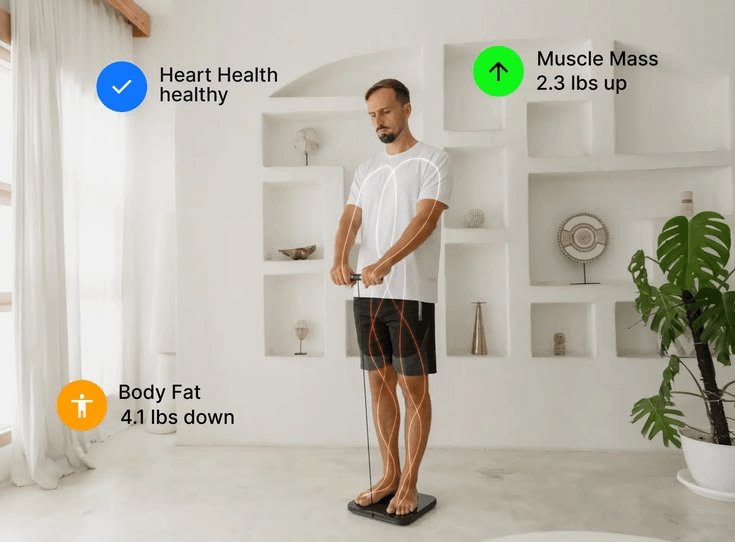
The Good
Trend Tracking Is Where It Earns Its Reputation
- The most consistent positive framing across all threads — focus on direction, not absolute numbers “Are the numbers accurate? Not really — but the trends are what I care about. I can see that the pounds I put on are not fat, and that’s a big deal for motivation.” (1 upvote)
- Tracks consistently with InBody machines for users it works for “My Hume body fat says 17.3% and the gym InBody says 16.4%. Trend in both has been consistent during my recomp. For a couple hundred bucks I’m pretty happy.” (5 upvotes)
Some Users Match DEXA Scans Closely
- The accuracy debate cuts both ways — and for some users it genuinely delivers “I just did a DEXA scan and it came back at 24% body fat, while my Hume scale showed 24.2%. My lean mass numbers were almost identical. That’s why I’m always confused when people say the Hume scale is way off.” (1 upvote)
The Segmental Breakdown Has Real Utility
- For users focused on muscular imbalances, the breakdown adds value beyond basic weight tracking “It actually helped me understand what segments were the most imbalanced so I could focus on unilateral exercises to even them out.” (2 upvotes) “I noticed my right quad was consistently showing 2% higher muscle mass which lined up with some knee issues I was having.” (3 upvotes)
The Not So Good
Accuracy That Varies Wildly Between Users
- The most documented and frustrating pattern“DEXA for me was 28.5% BF. Hume shows me at 19% BF. Very inaccurate for me personally.” (2 upvotes)
- Day-one readings that are physically impossible “Hume day one: 39%, 36%, 32%, 24%, 34%. My Renpho was right on the money at 29%.” (1 upvote)
- The scale claiming a pound of fat gained per limb in thirty minutes “I weighed myself first thing in the morning, then after my morning routine — lost 0.4 lb — and the scale told me I gained a pound of fat in each arm and leg. Impossible, no?” (1 upvote)
The App Is a Recurring Problem
- App frustrations come up in nearly every thread “The app makes me want to smash my phone with a hammer.” (3 upvotes)
- Data loss without warning “On the 7th day the app crashed, locked me out and erased all my info. 4 days later I got back in and it started me brand new.” (1 upvote)
- No data export, no Health Connect support for Android, Bluetooth-only sync — functional gaps that matter for anyone in a broader fitness tracking ecosystem
Paywall Creep on Features That Were Originally Included
- The most ethically frustrating complaint — features locked behind a subscription after purchase “App is routinely glitchy and now most useful features and tracking are locked behind a premium subscription paywall. I would not have purchased the scale knowing these features would be taken away.” (2 upvotes)
- The Hume Plus subscription costs $99.95/year on top of the already-premium hardware price
Other Concerns Worth Knowing
- Battery life falls well short of the advertised 30 days for multiple users
- Accuracy reportedly decreases at very low body fat percentages below 12%
- Users with metal implants should expect 3–4% deviation
- Readings vary significantly based on hydration, time of day, and food intake — a limitation of all BIA devices, not just Hume
How It Compares
- Withings — the most consistently recommended premium alternative; praised for long-term app support, reliability, and a decade-long track record of actually supporting older devices “Withings is more money but the better answer. Hume is fantastic at marketing but earning a reputation for not delivering the product sold.” (2 upvotes) “I have a Withings scale from 10 years ago that still works and is supported by their app. The Hume scale that is two years old is ‘no longer supported due to a security issue.’ Hume is junk.” (2 upvotes)
- Renpho — the most recommended budget alternative; more consistent, easier returns through Amazon, and a fraction of the price “As a non-owner, it seems the only thing slick about it is the marketing. I’m happy with my cheap Renpho that accurately measures my weight.” (1 upvote)
- InBody (gym scanner) — the practical gold standard for comparison; Hume tracks reasonably close for some users, not others
- DEXA scan — the true gold standard; Hume matches well for some users and diverges significantly for others
- Garmin scale — mentioned as an alternative with DEXA calibration capability worth considering
Tips from Reddit
- Weigh at the same time every day — first thing in the morning after using the bathroom, before eating or drinking, reduces variability significantly
- Moisten hands and feet before grabbing the handle sensors — improves BIA conductivity, especially if you have dry skin
- Focus on weekly or biweekly averages, not daily numbers — daily fluctuations are noise, not signal
- Weigh at least 4 times per week to build a more reliable trend line
- Zero the scale before stepping on — briefly press with your foot until it reads zero to avoid carry-over weight errors
- Give it time to calibrate — multiple users report readings stabilize and improve after weeks of consistent use before drawing conclusions
- Cross-reference with a gym InBody scan periodically to validate whether your trends are tracking accurately
- Use Apple Health integration if you’re in the Apple ecosystem — the most reliable data consolidation option currently available
Final Verdict
Reddit’s verdict on the Hume Scale is one of the more genuinely split we’ve covered — and the divide isn’t about preference, it’s about whether the device actually works for your body type.
- Genuinely useful for users whose readings track closely with InBody or DEXA, who treat the numbers as trends rather than absolutes, and who find the segmental breakdown genuinely informative for training decisions
- A frustrating and expensive mistake for users whose readings are inaccurate from day one, who hit app instability or data loss, or who need to return it and discover how difficult that process actually is


Leave a comment